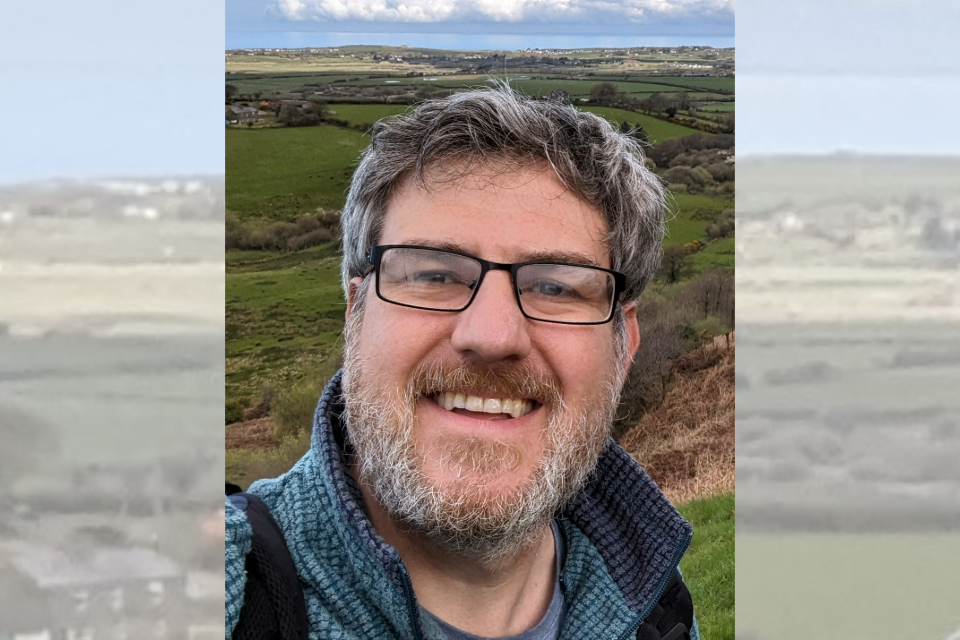
University of Liverpool geomagnetism expert Professor Andy Biggin has been recognised in the 2026 Royal Astronomical Society awards with the prestigious Harold Jeffreys Lecture.
The Harold Jeffreys Lecture is presented annually at a meeting of the Society. During his lecture, Professor Biggin will explore what records of Earth’s ancient magnetic field reveal about the planet’s dynamics and evolution.
Professor Biggin said: “It is a fantastic honour to receive the Harold Jeffreys Lectureship and join the list of distinguished previous recipients; I am so grateful to the RAS and my colleagues for the opportunity to present this prestigious lecture. Among his many achievements, Harold Jeffreys was the first to demonstrate that the Earth’s core is (mostly) liquid which is critical for explaining how Earth’s magnetic field is generated there. Giving a lecture named after him, that is based on the latest findings of the University of Liverpool’s Geomagnetism Group, therefore feels especially appropriate.”
Andy Biggin is a Professor of Geomagnetism and teaches geophysics at the University of Liverpool, leading the Geomagnetism Laboratory. Professor Biggin’s research focuses on describing and understanding the behaviour of the Earth’s magnetic field as recorded in rocks and archaeological materials. During his career, Andy has obtained magnetic records from materials ranging in age from the 20th century to 3.5 billion years old, collected from six continents. These have been applied to problems in geophysics, geology and archaeology.
The Royal Astronomical Society (RAS), founded in 1820, encourages and promotes the study of astronomy, solar-system science, geophysics and closely related branches of science.
Professor Mike Lockwood, President of the RAS, said: “I want to give my warmest congratulations to all the award winners.
“There is so much achievement recognised by the awards and also so much effort to spark interest in potential young scientists and to promote astronomy and geophysics.”