
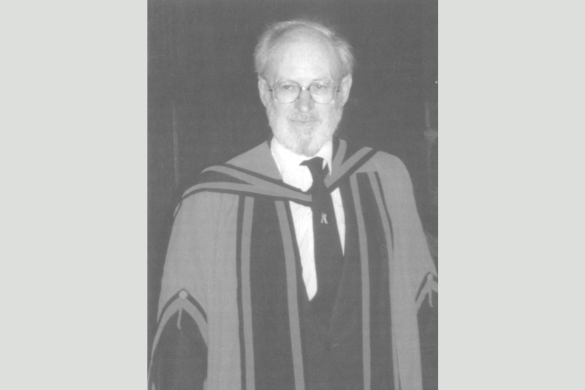
Michael Cook, distinguished archivist, scholar and educator, was born on 14 July 1931 in Hampshire. He read Modern History at the University of Oxford, where an early introduction to archival sources shaped the course of his professional life. In 1954 he joined the Bodleian Library’s archival training programme, marking the beginning of a career that would profoundly influence archival education, professional practice and international standards over more than half a century.
Michael’s first professional appointment was at the Devon Record Office, after which he was appointed City Archivist of Newcastle-upon-Tyne in 1958. In 1964 he took up the post of Curator and Archivist of the Sultanate of Zanzibar. Although this appointment lasted only five months, ending with the Zanzibar Revolution and the creation of Tanzania, Michael subsequently became the first Director of the National Archives of Tanzania, a role he held from 1964 to 1966.
In 1968 Michael joined the University of Liverpool as University Archivist. Alongside his curatorial responsibilities, he played a central role in teaching and research, educating students on the Diploma in Archives, particularly in the then-emerging field of records management. At a time when archival education was still largely grounded in early twentieth-century texts, Michael recognised the need for a modern approach that addressed the realities of contemporary record-keeping. This led to the publication of Archives Administration (1977), a landmark work that reshaped professional education for archivists working in local government and smaller organisations.
Michael was also a pioneer in the application of information technology to archives. He was among the earliest advocates of archival automation and standardisation, viewing archives as a vital component of the wider information environment. His leadership in this area included chairing the IT Group of the Society of Archivists between 1990 and 1995. Under his guidance, the Archival Description Project produced the Manual of Archival Description (MAD), a national forerunner to the International Standard for Archival Description (ISAD(G)). Co-authored with his Liverpool colleague Margaret Procter, later editions of MAD continued to be published even after the adoption of ISAD(G), reflecting its enduring value as a practical and interpretative guide. Michael also played a key role in the development of ISAD(G) itself through his membership of the ICA Ad Hoc Commission on Archival Description; the first draft of the international standard was completed at a meeting in Liverpool in 1991 and published in 1994.
Beyond Europe, Michael’s influence was truly global. In 1975 he returned to Africa to establish the UNESCO-funded Archival Training Institute for Anglophone Africa at the University of Ghana. Throughout the 1970s and 1980s he undertook further UNESCO consultancies in Southeast Asia and the Caribbean, producing influential reports for UNESCO’s Records and Archives Management Program. This international work continued through his involvement with the International Records Management Trust and resulted in two further practical manuals: Managing Archives: A Procedures Manual (1999) and Managing Records in Records Centres (2000).
Michael was deeply engaged with the International Council on Archives, serving as Chair of its Education and Training Committee from 1984 to 1988 and later as a member of the Commission on Archival Description from 1990 to 1996. He also held visiting lectureships in Turkey, Portugal, Spain, Egypt, Ghana, Slovenia, Brazil and China, including a visiting appointment in 2001 at the Archives College of Renmin University of China.
After retiring in 1994, Michael remained closely connected to the University of Liverpool as an Honorary Senior Fellow in the School of History. He was awarded a PhD by publication in 1998 in recognition of his exceptional scholarly contribution. He was a co-founder of the Liverpool University Centre for Archive Studies (LUCAS) and continued to play an active role in its work for many years, attending events regularly and contributing to major initiatives, including the influential 2003 conference Political Pressure and the Archival Record.
Michael’s later work increasingly addressed ethics, access and the societal impact of archives and records management. His 2006 article on professional ethics in a human rights context influenced the recent revision of the Archives and Records Association’s Code of Ethics, while his writings on appraisal, access and the “datafication” of archives anticipated debates that are now central to the profession. His thinking consistently combined meticulous attention to professional practice with a deep concern for social justice and the public good, underpinned by his strong Catholic faith.
Despite his international standing and formidable intellectual legacy, Michael was known for his humility, generosity and collegiality. He remained actively involved in student recruitment and doctoral supervision at Liverpool until around 2012 and was widely regarded as the most influential figure in international record-keeping since Sir Hilary Jenkinson, recognised by his award of the Ellis Medal by the Society of Archivists in 1992 and the Distinguished Service Award by the same body, now renamed the Archives and Records Association, in 2022 (the only individual to have achieved both honours).
Michael is survived by his wife Margaret, with whom he had five children and many grandchildren. The University of Liverpool extends its deepest condolences to his family and honours with gratitude his extraordinary contribution to the University, the archival profession and the international scholarly community.
Words by Dr Alex Buchanan, Co-Director of Liverpool University Centre for Archive Studies