
Professor Ric Williams of the University of Liverpool’s School of Environmental Sciences and Dr Pete Brown from the National Oceanography Centre have published the latest findings from their international research team in an article in Communications Earth & Environment.
It is well documented that the Gulf Stream plays a pivotal role in the climate system through its transfer of heat, which ultimately supplies warmth to northern latitudes in the North Atlantic. What remains less well understood is how the Gulf Stream influences the climate system by transporting nutrients and carbon. These materials stimulate plankton growth, which in turn play a vital role in naturally absorbing carbon dioxide from the atmosphere.
The North Atlantic is one of the most effective locations in the global ocean for carbon uptake, accounting for 23% of the global air-sea carbon uptake, despite only accounting for 11% of the surface area. Understanding what drives this ocean carbon uptake could have major impacts for the planet and how effective the natural carbon cycle will be in curbing the ongoing rise of atmospheric carbon dioxide.
The article sets out the view that the Gulf Stream affects the carbon cycle in two different ways.
Firstly, the Gulf Stream carries sub-surface waters northwards that have high concentrations of nutrients, which allow plankton to grow and draw down carbon from the atmosphere when those waters reach the surface further to the north.
Secondly, these nutrient-rich waters carried by the Gulf Stream were last in contact with the atmosphere many decades ago, and have the capacity to take up additional carbon when they reach the sea surface due to the ongoing rise in atmospheric carbon dioxide. This viewpoint is supported by analyses of historical data and experiments with ocean circulation models.
Theses findings will be further explored by the £4 million collaborative C-Streams research project which is investigating how the Gulf Stream affects the climate system through the transport of nutrients and carbon.
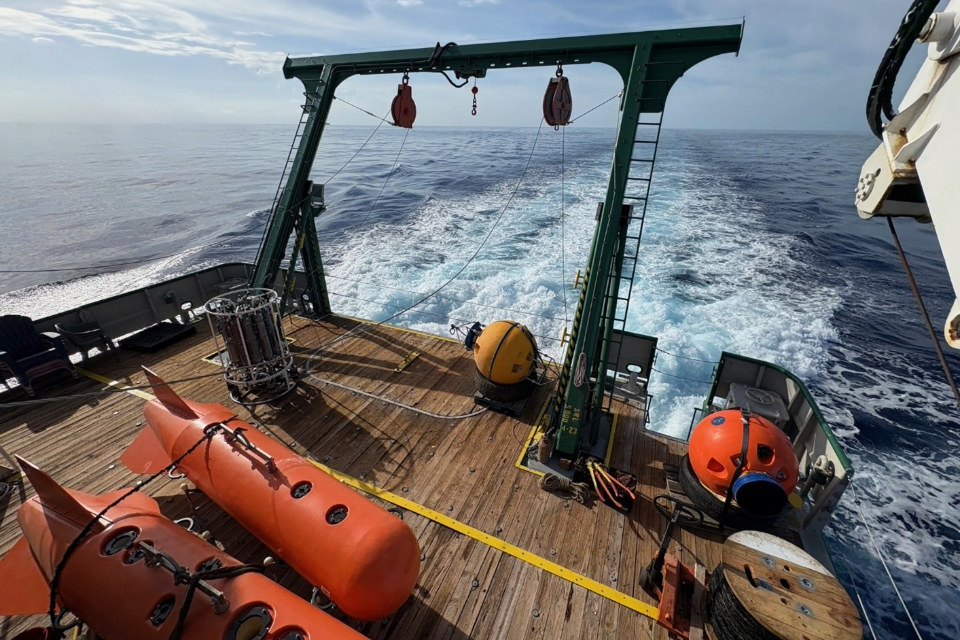
The team have been monitoring the daily properties of nutrients and carbon carried in the Florida Current that forms part of the Gulf Stream for the last two years, examining the mixing and stirring in the water column and evaluating the downstream evolution of biogeochemical properties. The aim is to understand how the North Atlantic carbon sink connects to the properties carried by the Gulf Stream.
This video highlights the research being undertaken:

The international team involved in this article include researchers from University of Liverpool , National Oceanography Centre, British Antarctic Survey, Norwegian Research Centre and Massachusetts Institute of Technology.
The wider team involved in the C-Streams research project include scientists from the UK from National Oceanography Centre, the Universities of Liverpool and Southampton, the Scottish Association of Marine Science and the British Antarctic Survey, and from the USA, the University of Miami.
You can read the paper here: https://doi.org/10.1038/s43247-025-03118-y