
A new University of Liverpool spin-out, Apoello, has secured £470k in pre-seed investment to accelerate the commercialisation of its AI-enabled materials discovery platform.
The funding will support team growth, further platform development, and early engagement with industrial partners.
The investment round includes £320,000 from SFC Capital and the British Business Bank, alongside £150,000 from the University of Liverpool.
Officially spun out in October 2025, Apoello was formed from materials science discovery expertise within the University’s Department of Chemistry.
The company aims to digitise the materials science process, making it quicker, easier, and more cost-effective for researchers to discover new materials for applications such as organic electronics and renewable energy technologies.
Current materials discovery methods rely heavily on physical experimentation, with researchers often spending months testing compounds that ultimately prove unsuitable.
The company’s technology builds on the DiaDEM research programme, creating a digital discovery environment that combines large-scale molecular data with advanced computational modelling and procurement capabilities. By reducing reliance on failed experiments, Apoello aims to significantly shorten development timelines and reduce costs across the sector.
Dr Ömer Omar, Chief Executive Officer and Co-Founder of Apoello, and Research Project Coordinator in Chemistry at the University of Liverpool, said: “This investment marks an important step in translating world-leading research from the University of Liverpool into a commercial platform with real industrial impact. Our goal is to remove inefficiencies from materials discovery and give researchers the tools they need to focus on the most promising candidates.”
Apoello was formed from the EIC Transition project DiaDEM and is co-founded by Dr Omar and Professor Alessandro Troisi, Chair of Theory and Simulation of Materials at the University of Liverpool and a globally recognised expert in computational chemistry.
Ed Stevenson, Principal at SFC Capital, said: “We’re excited to back Ömer and the team as they build technology that can meaningfully improve how researchers design and test new materials. Apoello is well positioned to bridge the gap between academic innovation and industrial application.”
Professor Anthony Hollander, Pro-Vice-Chancellor for Research and Impact at the University of Liverpool, said: “We are delighted by this investment in Apoello, which showcases the strength of the pioneering materials discovery research behind the company and the commercial potential of its technology. This spin-out exemplifies our commitment to translating world-class research into real-world impact, supported by strong partnerships with investors and industry.”
Next steps
The funding represents a key milestone in Apoello’s transition from research to commercial delivery. The company will now focus on scaling its technical capabilities and working with early industry partners, particularly within the organic electronics sector.
The University of Liverpool’s Enterprise Team supported the formation of this spin-out, fostering a thriving entrepreneurial ecosystem and a cluster of high-growth companies across the Liverpool City Region and beyond.
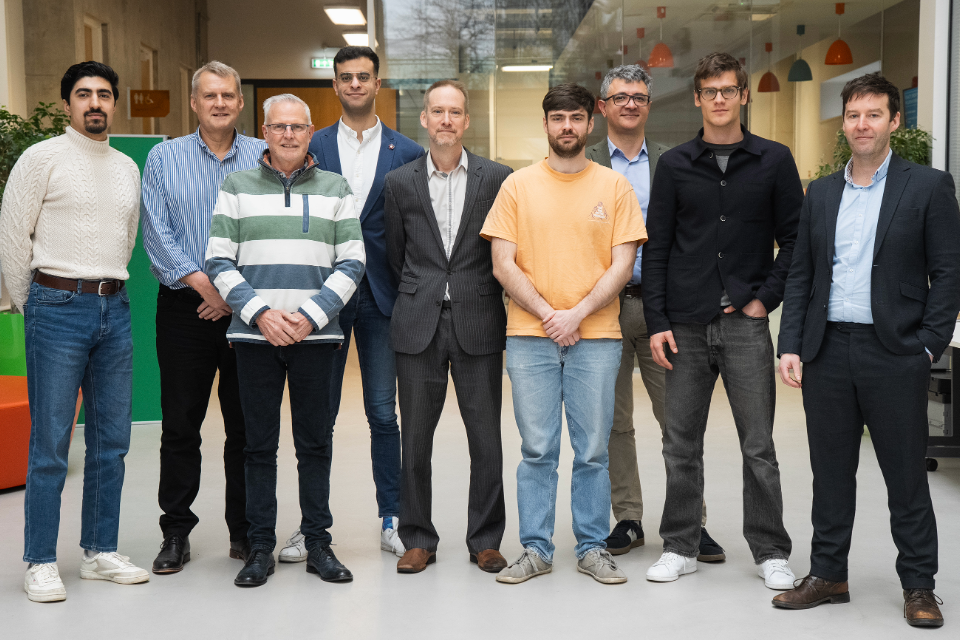
Photo (from left to right): Ömer Omar, Simon Tuley, Tony Travers, Abdel-Rahim Abdalla, Russell Payne, Adam Coxson, Alessandro Troisi, Alfonso Gambino, Thomas Pugh.
Materials Discovery research
This work forms part of the University’s Materials Discovery frontier, which accelerates solutions to tackle net-zero challenges through pioneering digital materials design and automation. Our research has applications in clean energy, healthcare, sustainable living and consumer products, and we work with major global partners to translate original ideas into real-world impact. Discover more: https://www.liverpool.ac.uk/research/frontiers/materials-discovery/.