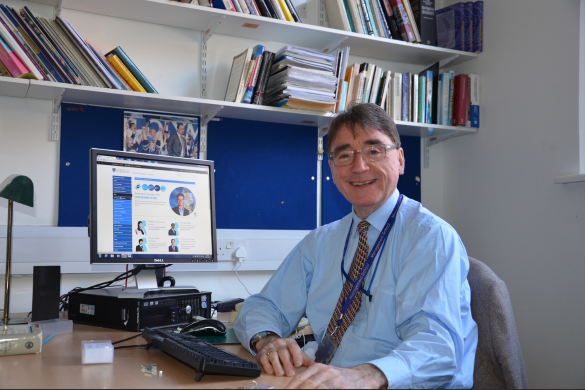
Words by colleagues in the University of Liverpool Management School
It is with great sadness that we learnt of the passing of Tom Cannon, Professor of Management and more recently Emeritus Professor of the Management School. Tom’s brilliant career spanned over 50 years, making substantial contributions at national and international levels, bridging academia, policy and practice. Growing up in Kirkby and educated at St Francis Xavier’s Grammar School and South Bank University, throughout his career Tom lived his belief in the value of education as a force for change. Whatever task Tom addressed or position he held, he brought to it an energy, passion and infectious enthusiasm which together with his communication skills and knowledge, proved to be an effective leader for change in across academia, governments and professional organisations.
Tom was prepared to take risks and argue the case on matters that he cared for, including marginalised groups, and demonstrated this as an engaged scholar, through his roles, publications, thinking and activities. His entrepreneurial streak and drive to make things happen was an enduring characteristic which involved a variety of leadership roles inside and outside academia. In the early 1980s, for example, together with a coterie of academics, Tom helped to persuade Clive Woodcock, then a business editor of The Guardian newspaper, to launch the European (now International) Small Business Journal, as the first UK based peer reviewed journal in the emerging field of entrepreneurship – then viewed by the mainstream as a marginal activity. Tom’s early senior positions involved a foray into academic management, becoming Founding Dean of the Management School at Stirling University and then Director of Manchester Business School (MBS). Subsequently, he then stepped out of higher education to become Chief Executive of the UK government’s Management Charter Initiative and later the Management and Enterprise National Training Organisation, which sought to raise the quality standards of management in business. This was followed by a short position of Dean of the School of Business at Buckingham University.
However, despite reaching the heights of senior positions in the UK and internationally, Tom never lost sight of his roots and love of Liverpool and in 2008 he was appointed Professor of Management at ULMS. Here he embraced various roles, working closely with others to develop the MBA Thoroughbred Horseracing Institute, securing scholarships from the Racing Foundation and the Jockey Club. He supervised over 50 doctorates and numerous masters and MBA students on the Football and Horseracing programmes. Whatever stellar accolades and appointments he achieved from around the world, Tom was particularly proud of his mentoring and supervisions. Students were grateful of his time, insightful feedback, and willingness to give them any help that he could to make sure that they passed with good grades. Providing them with the knowledge to do better for themselves and achieve their educational and career aspirations.
Interleaved with his academic career, Tom also pursued various roles and campaigns that reflected his multifaceted interests and desire for change in society and the economy. For example, he was appointed Chief Executive of the Respect London, a charity set up by Anita and Gordon Roddick and over the decades he continued his dedication to challenging inequalities through his research and presentations across a range of media.
However, to know Tom also required an appreciation that he was a devout supporter of Everton FC and such was his dedication to its success that he was involved in a consortium to raise money to buy it. Tom was not one to sit back and let the world go by especially on matters close to his heart. As a staunch Evertonian and season ticket holder, friends and colleagues in ULMS would often be drawn into conversations on the latest happenings on and off the football field, with Tom offering incisive post-match analyses or views on the condition of the club, and what needs to be done.
Tom’s passing has affected people who had the privilege to know him – friends, colleagues and students. We extend our condolences and thoughts with his wife Fran and family at this difficult time.