
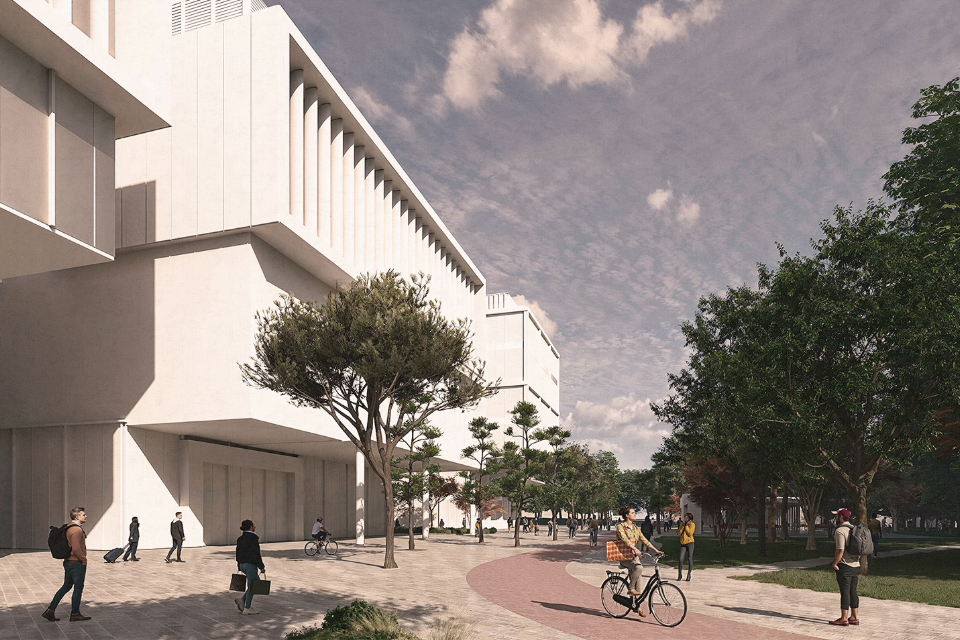
A public consultation has launched today to gather views on the next phase of development at Paddington Village South – a government-backed regeneration project on land next to Grove Street.
The project marks the next step in the flagship Knowledge Quarter development and a masterplan has been developed to showcase the proposals and set out plans for new research, innovation and education facilities as well as mixed-use community facilities and enhancements to the green space, and walking and cycle routes.
Get involved
University staff and students can view the plans and share views via a dedicated website which is now live and will remain open to gather feedback to help shape the proposals midnight on Sunday, 19 April 2026.
There is also a university community drop-in event planned to take place in Liverpool Guild of Students on Tuesday, 17 March 10am – 5pm.
Plans for growth
Bounded by Grove Street, Smithdown Lane and Oxford Street, the plot of land is jointly owned by the University and City Council; and the masterplan proposes to create development opportunities for materials chemistry innovation and chemical sciences education alongside mixed-use community facilities.
These will be delivered through five initial development plots creating:
- Two world-class university chemistry facilities
- Two commercial laboratories and workshops
- A multi-functional pavilion, catering to both community and commercial purposes
The project is being funded with a mixture of local, regional and government funding, alongside university and private investment. The most significant part of the plans for the site is the chemical science building, which will house the AI Materials Hub for Innovation (AIM-HI). AIM-HI will be a flagship national facility dedicated to accelerating the application of artificial intelligence in materials chemistry. The Hub will feature state-of-the-art research and translational spaces, as well as an innovation incubator designed to foster collaboration between academic and industrial researchers and support the creation of new spin outs.
The City Council has already received a multi-million pound grant from Government to acquire some of the existing buildings, including the former Smithdown Lane Police Station, which has now been demolished as part of the plans for the site. Some university-owned buildings also exist on the site, including the veterinary practice and a building which is currently leased to Kids in Bloom nurseries.
As part of the broader programme to improve Liverpool’s cycling and walking infrastructure, the plans see the current nursery building earmarked for demolition by late 2028. Whilst this planning is long term and the current nursery provision will continue with no anticipated changes for several years, options are already being pursued by the University in partnership with Kids in Bloom for the relocation of the childcare facilities close to our campus to help ensure continuous provision for parents who use it. This includes University staff and students, but also the wider community who value the high-quality provision and location close to the city.
As a long-term prospect, any future plans will fully consider the relocation of the vets practice, and it is envisaged that operations will be able to continue to operate normally during the initial development of the site.
Public green space
Also central to the development will be a revamped 9-acre public green space around Grove Street, with the aim of improving biodiversity by 10% as part of the city’s wider ‘Urban Green-up’ Programme.
Once complete, the new green space will be aligned with the Liverpool Public Realm, and Design for Access for All strategic planning, and the Council and University’s net zero ambitions. It will aim to integrate safe and accessible connections within a growing active travel network, re-establishing Crown Street as a key connection into and through the area.
Estate Strategy 2031+
Paddington Village South is central to the University’s Estate Strategy 2031+ which presents a clear, long-term vision for the future of our campuses, acting as a guide for our planned land and building investments.