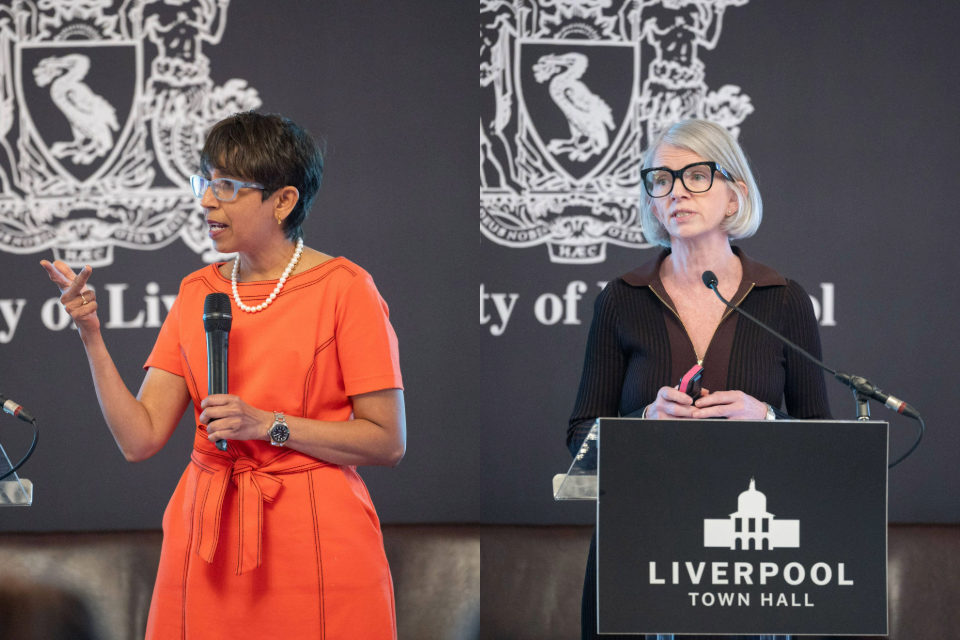
University of Liverpool Professors Louise Kenny and Shakila Thangaratinam came together to advocate for improved women’s health and to support the next phase of work to address long-standing health inequalities across the city.
The Women’s Health Conference, organised by Liverpool City Council’s Public Health team, brought together women with lived experience, community organisations, health and social care partners, researchers and system leaders to share evidence, listen to experiences, and strengthen collective advocacy for women’s health in Liverpool.
Women in Liverpool experience poorer health outcomes than women nationally. Many experience ill health around 10 years earlier than women elsewhere, and on average spend around 30% of their lives in poor health. Women are also more likely to die early from preventable causes, with a wider inequality gap than is seen for men. These outcomes are shaped by persistent social, economic and gender inequalities.
However, women’s specific health needs are not always well recognised or supported, with many women reporting feeling unheard or unsupported when seeking help. The conference was delivered to provide a shared space for these experiences and evidence to inform discussion, reflection and learning.
Professor Louise Kenny, Pro Vice-Chancellor of the Faculty of Health and Life Sciences at the University of Liverpool, said: “The evidence and lived experience highlighted here show how deeply inequalities shape women’s health outcomes in Liverpool. Universities have an important role in working in partnership with the NHS, local government and communities to strengthen the evidence base, improve how women’s health is understood, and ensure that research leads to real-world change. By collaborating across research, policy and practice, we can help deliver more equitable and effective improvements in women’s health.”
Professor Shakila Thangaratinam, Executive Dean of the Institute of Life Course and Medical Sciences at the University of Liverpool, added: “Throughout my clinical practice, research and global health work, I have seen how profoundly women’s health outcomes are shaped by social inequality, access to care and whether women feel listened to and believed. In Liverpool, these challenges are particularly stark, but so too is the strength of partnership and commitment to change.
“Bringing together women with lived experience, communities, health services and researchers is essential if we are to close the gap between evidence and everyday care. The work taking place here reflects exactly the kind of collaborative, life-course approach needed to improve outcomes for women and girls, locally, nationally and globally.”
Professor Matt Ashton, Director of Public Health for Liverpool City Council, said: “We know the data and we know the challenges. What makes today different is the focus on delivery. By bringing together lived experience, community leadership and system decision-makers, we are creating the conditions for real progress. This is about working differently, and better, for women in Liverpool.”
The Health of Women in Liverpool report can be found here on the Liverpool City Council website.